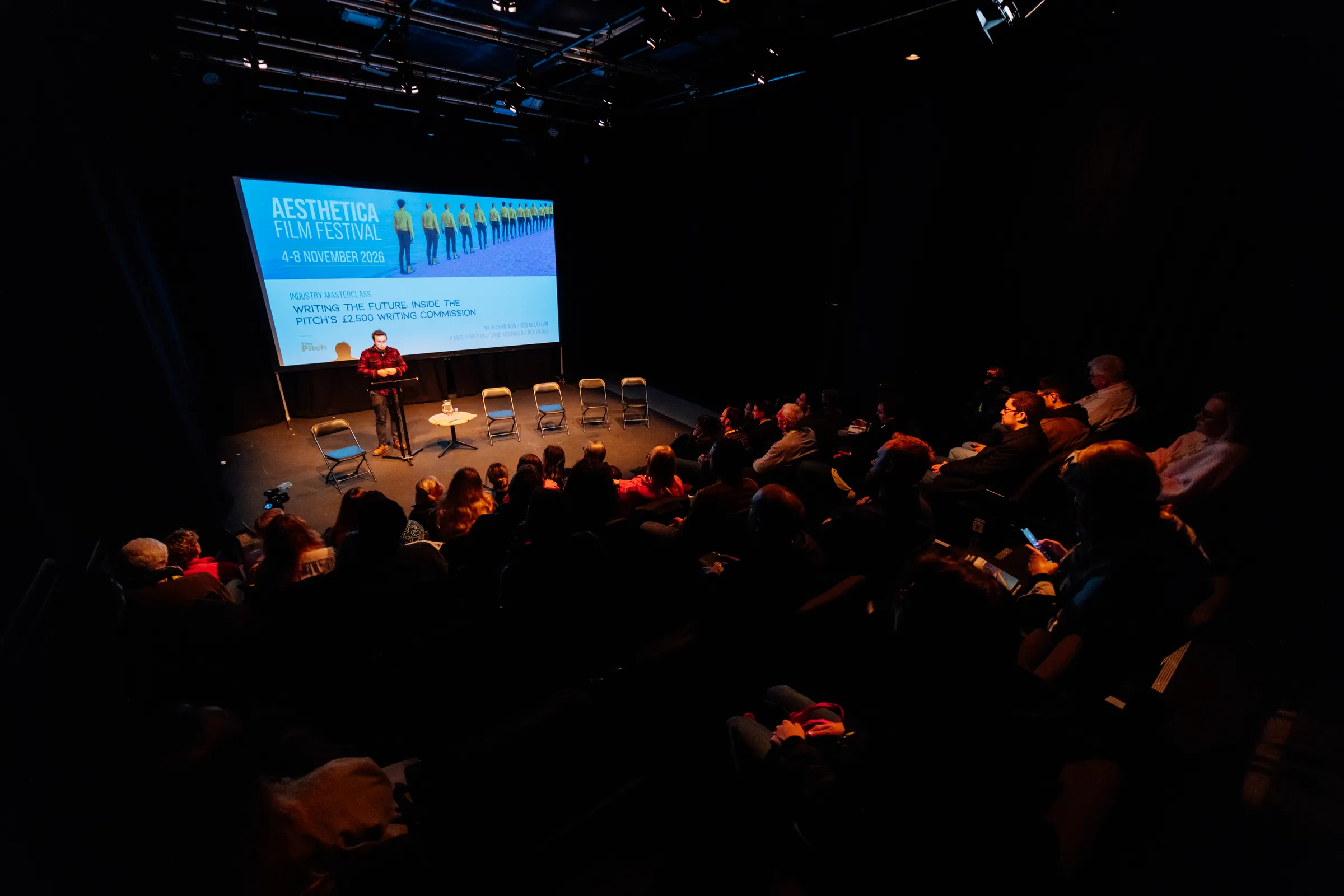
Keynote Speech from the Commission Launch
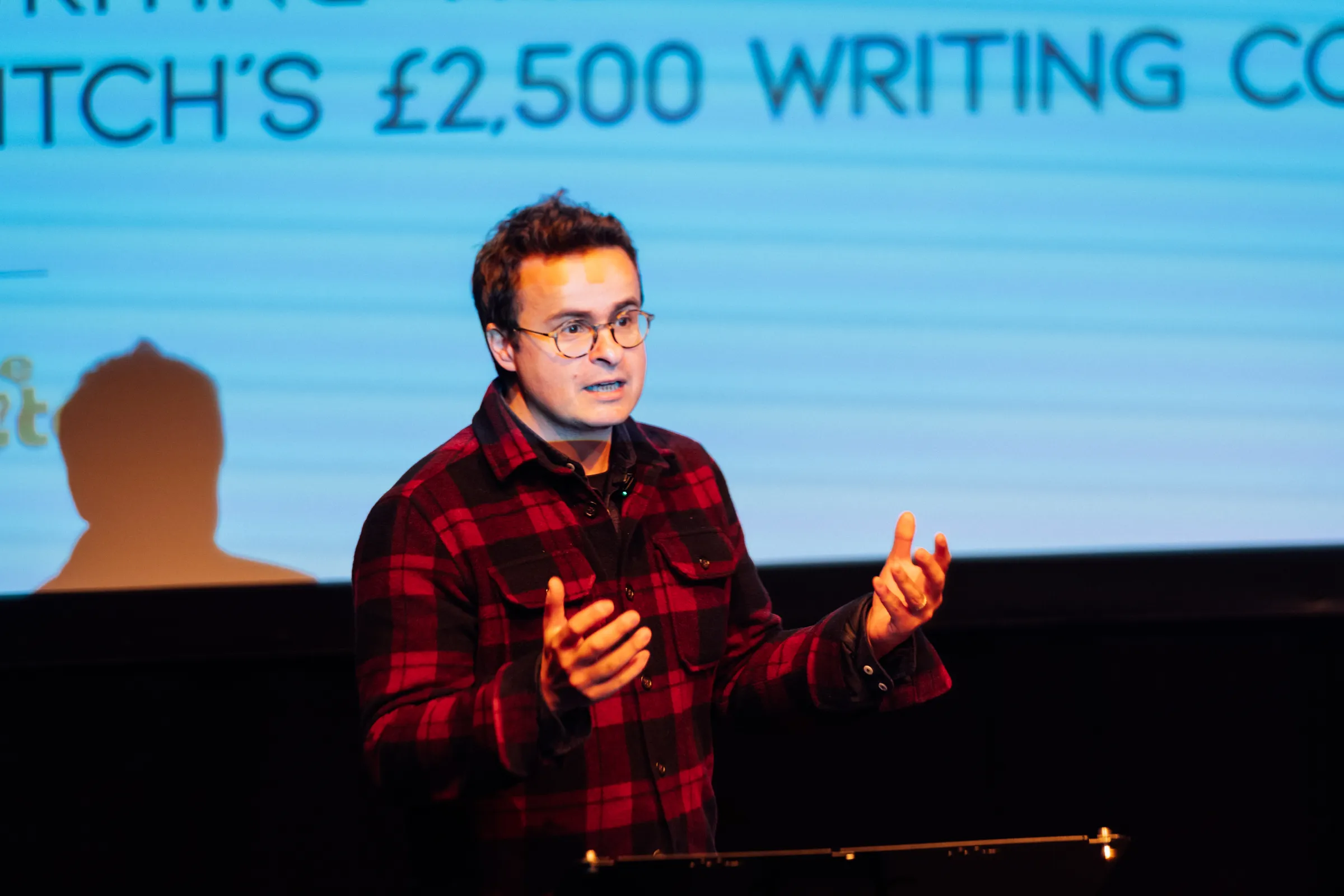
Nathan Mladin speaks on the topic of 'What does it mean to be human in the age of AI?' as part of The Pitch Masterclass, 'Writing the Future' at Aesthetica Film Festival.

The Pitch Team
Watch the keynote from Nathan above, or continue to read the transcript.
Our anti-human moment
It's really great to think with you about this topic that is kind of annoying everyone. We're always talking about it, and I'm almost getting fed up with it. But every time I want to give up, there's a new angle that I see. There's a new provocation that it brings to reflect deeper on the questions that matter.
In June last year, former New York Times columnist Ross Douthat sat down with Peter Thiel for a wide-ranging conversation about AI, transhumanism and the religious imagination of the tech industry. If the name is not familiar to you, Thiel co-founded PayPal and Palantir and was the first outside investor in Facebook. Thiel has actually bankrolled a great deal of the future that we now call the present.
Douthat had been asking him about the people in Silicon Valley who are talking about merging with machines. This is the transhuman vision. Or who even see AI as a successor species. Then he asked what should have been a very easy question to answer:
“You would prefer the human race to endure, right?”
There's a very long pause from Thiel.
Then Ross intervenes: “You're hesitating.”
Then Thiel continues: “Well, I don't know. I would…”
“This is a long hesitation,” says Douthat.
Then Thiel is like: “Well, there are so many questions implicit in this-”
And at that point, Douthat asks point-blank: “Should the human race survive?”
Again, silence, hesitation.
And then a timid:
“Yes”.
Then he continues.
It's really the pause, the awkward hesitation, that I found rather chilling, because for a few long seconds, on the record, one of the most influential investors in technology couldn't quite bring himself to say that human beings should have a future.
But I worry that pause and Thiel's hesitation bespeaks the perilous moment we find ourselves in.
There's a long history to that sort of pause. In his book, The Revolt Against Humanity, the poet and critic Adam Kirsch observes that what was once an unthinkable, unmentionable proposal has begun to sound plausible in our time: that humanity's reign on the Earth may be approaching its end, hastened by the advent of superintelligent AI, and that rather than dreading our extinction, we should welcome it, passing the baton even to a new successor species.
I think this encapsulates what I am calling our anti-human moment. For the most part, this kind of anti-humanism does not take a conscious, overt form of hatred of people. It's rather more like a whisper, an insidious voice that suggests that the human condition, our limits, our interdependence, our fragility, our vulnerability, the friction of messy human relationships, our finitude, our mortality, grief, are not realities to be borne and lived through, but problems in search of a technological fix, defects to be corrected.
Writing the future
The title of this session is “Writing the Future”. Actually, it got me very excited, and I hope you will understand why by the end of this talk. But let me just say what should be obvious: I'm not here to predict the future. I'm not a seer. There's no crystal ball in my luggage.
I'm only someone who spends a fair bit of time thinking about what technology, and specifically AI, is doing to us, to our relationships, to our homes, to our workplaces. But also, importantly, what AI - or rather, without personifying AI, what AI developers and investors and the AI commentariat - are assuming about us as human beings.
So in the next few minutes, I want to sketch out what I feel are the human stakes of this moment, and then suggest why filmmakers and storytellers matter so much in shaping what comes next.
What does it mean to be human?
The question that I've been asked to address, and that is often addressed around AI, is: what does it mean to be human in the age of AI?
Although I've spent quite a bit of time thinking and writing and researching this topic, every time I get asked that question, it stumps me. In fact, I was on the radio last week and the presenter asked me point-blank: “What does it mean to be human?” I should have known. I should have had the answer prepared. But it stumped me, as it does always. It leaves me scratching my head. What does it mean to be human?
But I actually think that this temporary loss for words is probably a good thing, because if there was a ready-made answer that one could just give straight away, it would likely be a thin one. It would likely be a flat, perhaps reductionist picture of what it means to be human.
I have a hunch that this question often hides a certain anxiety that we probably all feel, and perhaps even experience viscerally. Behind the question “What does it mean to be human?” is perhaps the question: "Is there something special about being human?" Is there something that sets us apart from machines whose capabilities, we are told, are developing exponentially and will overtake us?
So, on the one hand, human distinctiveness or human uniqueness: what makes us special? But on the other, many of us might feel the pull in the other direction. We're wary also of human exceptionalism, as it's sometimes called, and for good reason, because the belief that humans stand above and apart from everything else has licensed a great deal of harm to other humans and to the living world and other creatures on which we depend, literally.
So there's this ache, in that we would like to believe there's something unique, irreducible about humanity. But we instinctively shrink back on hearing quick claims to our superiority and uniqueness.
The philosopher and theologian Simon Oliver of Durham University says that the culture shock of AI is, "a crisis of the human, of our self-understanding, of our perception of value and our sense of purpose”.
What he goes on to call for is, above all, I quote, “a recovery of the deep mystery of our own being”. The deep mystery of our own being.
Now, that might sound a little bit grand, perhaps even nostalgic, but I think it's because, in our mechanistic and materialistic milieu, we have lost sight of that mystery, have lost that vocabulary altogether.
Understanding ourselves through our machines
We are, I think, mysteries to ourselves. But at the same time, we are homo faber. We are human makers, and as such, we have always made things, created artefacts, not only to express our creativity, to extend the boundaries and to unfurl the potential of the world, but also to understand ourselves.
The tendency to understand ourselves in terms of the most impressive technologies of the day has been a very strong one in the West. If you look at intellectual history, you see that we've imagined the human - and I'm using the word “imagine” carefully here - as a loom or as a clock. Or if you take Freud, for example, Freud's conception of the human psyche is based entirely on the picture of the person as a steam engine, with hydraulics, with pressure valves and things.
Today, in the so-called “age of AI”, we are understood as fragile and slow versions of an extraordinarily powerful artificial intelligence with superhuman capacities. Each of these imaginings, each of these pictures, can be useful in helping us understand something of the complexity of the reality they describe. But they're also very dangerous when they harden, when we mistake them for the reality they depict but never exhaust. When we take the map for the territory.
Just think of the phrases we routinely use: “We need to recharge our batteries.” “We don't have the bandwidth.” “We're processing this or that.” “We're running on empty.”
Of course, this is all figurative language, and on one level we know that. But I fear it's actually simply how we've come to conceive of ourselves: as meat machines, as slow biological variants of AI.
So now the reference is AI, is the machine. In the debate about whether AI might be conscious, the brain as computer, which is the reigning paradigm in neuroscience and cognitive science, is no longer treated as a simple metaphor, but is actually a literal statement. We are believed to be computational systems.
Now, Aristotle famously said that art or artifice imitates nature. The things we make copy or mimic something already given. A pump imitates the heart. A robot arm imitates a limb. But somewhere, I think, along the way, we have reversed the order and have begun to think that nature imitates artifice: that the heart is a pump and that the brain is a computer.
Becoming like the things we make
The Jewish and Christian traditions hold that humans are themselves made in the image and likeness of the divine, of God. But the more we understand ourselves as an image of our own technology, the net result is that we end up diminishing ourselves. We forget it's us who've made the loom, the engine, the LLMs. Instead of wondering at ourselves, at the mystery of our humanness, we become fascinated, gripped, intoxicated even, with our own creations.
This is an old pattern that scriptures have a word for, which is idolatry. This is the ancient temptation that the Hebrew writers identified with acuity. The Book of Psalms describes the objects people make with their own hands, and then place their trust in to save them, to deliver them from peril or whatever. One verse says:
“They have mouths, but do not speak; eyes, but do not see. They have ears, but do not hear.”
We see that's quite different today, because today's idols have mouths and speak, eyes and see, in some sense. Then comes the upshot: those who make these idols and trust in them become like them.
What we make and then look to for meaning, and trust to usher in the AI utopia, slowly remakes us, slowly deforms us. The same pattern holds with large language models, which speak fluently our language because they are trained on our language and our creative output, and powerfully imitate certain, but definitely not all, aspects of intelligence.
The more we look to machines to tell us what we are, the more we conform ourselves to them and diminish ourselves.
AI as a mirror
The philosopher of technology Shannon Vallor at Edinburgh University offers a helpful image for all of this in describing AI as a mirror. LLMs are complex systems that are trained on the vast record of human expression and creativity, which they reflect back at us.
Now, of course, a mirror is a very good, useful object, an artefact, as long as we remember that there is a gap, and there are important differences between the person looking in the mirror and the image, the ghostly reflection on its surface.
Applied to AI, with Vallor, we'd have to observe that AI doesn't actually mirror our depth and complexity, let alone our mystery. It actually mirrors an already impoverished picture of ourselves. A picture in which the body is incidental to our personhood, where the only intelligence that actually counts is recognising patterns and solving problems, getting stuff done. One where consciousness is little more than information processing.
So the AI mirror hides more than it actually reveals about us. You can hear this in the language used by AI companies and leaders in AI. Whenever you hear the language of “human-level” or “superhuman” AI, being human, if you notice, is actually quietly reduced to getting stuff done, to problem-solving.
Vallor asks what this says about us: what metric for the value of a human life do we endorse when we claim that a machine that does nothing else but compute and produce has earned the title of “superhuman”? She asks:
Are you solving a problem when you are spontaneously patting your child's head with affection? Are you optimising your production yield when you do a cartwheel in the grass? Are you calculating your most efficient path when you stop in the street to check in on a stranger in distress?
What AI unveils about our culture
Before the word came to refer to cataclysmic events and catastrophes, the word “apocalypse” meant, and still means, an unveiling, a revealing of something that perhaps was hidden, obscured for a while.
I think that, in that older sense, AI is apocalyptic. It's an apocalyptic technology. It unveils what our culture has valorised for far too long: the mind and instrumental reason over against the body; information over wisdom; speed, efficiency, convenience over the slow pursuit of what is true, what is good, what is beautiful.
I think AI is also apocalyptic in the sense that it unveils and reinforces our exclusionary biases and our patterns of violence. We can see, for example, what this amounts to in this rise of so-called AI companions. You have chatbots that are now simulating emotional reciprocity with increasing plausibility, and offering, in Vallor's words, user-specified and customised experiences of companionship, which can be platonic, romantic or sexual, for those who find companionship with other humans too inaccessible, demanding, scary, daunting or simply inefficient.
They're very good at simulating empathy. Like social media, they're built to keep us “engaged”, a euphemism if ever there was one. At a time when I think the patient practice of attention, of care, of love is already under strain, they are actually a calamity waiting to happen.
So who's to blame for this? Now, of course, it's easy to point fingers, and I think we're right to do that, to call out big tech, to call out AI companies. But Vallor says something a bit more bracing than that, and says that the danger to our humanity is not so much from AI. The call is coming from inside the house.
AI can devalue, she says, our humanity only because we have already devalued it ourselves.
Renewing our imagination through stories
Okay, this is all bad news! But it doesn't have to stay that way.
The problem concerns how we see ourselves, how we understand ourselves. What images of ourselves have we allowed to take our imaginations captive?
But these images can be changed, particularly through stories, through compelling stories. Our imagination for being human can be renewed.
I've actually come to think of AI as a sort of negative space in painting. Negative space is that which surrounds a figure and allows it to stand out. So, as machines are said to take on more of what we thought defined us, they throw into relief parts of our humanity that we have neglected.
As I've said before, the body, our spontaneity, our ability to stand back and consider our actions, our moral freedom, our ability to live with uncertainty and to imagine and to foster a future that isn't simply a warmed-up version of the past. The mirror can only show us what's behind, but we can look ahead, not just in the mirror. We can imagine fresh possibilities and richer ways of being human.
This is where you come in, because sci-fi in literature and film has imagined this cultural moment long before it's arrived on the scene. Blade Runner, Ex Machina, Black Mirror, Her. Our culture has rehearsed these hopes and tropes about thinking machines. Some of what was imagined in quite outlandish scenarios - this is the strangeness of the moment - is now basically headline news.
Fictional stories have become lived realities, and there are actually empirical studies to show just how influential sci-fi has been in shaping the imagination of AI developers and builders. But good filmmakers will always show us who we are, interrogate facile pictures, and also help us imagine what else we might become.
I'm convinced that if we are to have a human and humane future, we need better, richer, more authentic pictures of ourselves. I think storytellers and the rich medium of film are uniquely placed to do just this: to expand our impoverished imagination of what a human being is, to break open the confines of a mechanistic view of life, to loosen our fascination with the things we've made, and to reacquaint us with the depth and mystery of being human.
A renewed commitment to the human
So what would these better, richer pictures look like? Let me put a stake in the ground and say: I think we need a renewed commitment to the human.
As Luke [Director of The Pitch] was mentioning, to express this, if you would like to, this is our invitation: I would say consider the Christian tradition and the Bible as one of the oldest collections of narratives that wrestle with this question of what it means to be human, in the way that Luke has already mentioned.
There are resources available on the website that can help you navigate this text, and some lenses through which you can explore this question further. These include Christianity's absolutely unique, stark claim that divinity has become material, that transcendence has taken on human flesh and has embraced the human condition fully, which is also a powerful statement about the intrinsic goodness of materiality and of embodiment in particular.
You'll also find fresh ways of thinking about human identity through the idea of the face and of name, and how they function interpersonally; of the importance of memory and remembering; and, of course, of imagining hopeful futures.
What kind of human future will you imagine?
Let me close, returning to where I started. Asked whether the human race should endure, one of the most powerful men in technology paused for a very long time before he issued that worryingly timid “Yes”.
The questions I would leave with you are: will there be humans in the future you imagine? And if so, what kind of humans? Enfeebled users of the latest tech, willing slaves of our own creations? Or the embodied, mysterious creatures that we are, creatures who name their children, who mourn their dead, who wonder at the world, who smell roses for the love of it and keep bumping into neighbours?
Our hope at The Pitch is that you wrestle with this question of what it means to be human and draw inspiration from this ancient yet strangely living, dynamic text, from the long history of reading it, and use these lenses to see the human condition afresh. To help us resist the dehumanising pull of technology, especially technology seen as a machine god, and to stretch our imaginations towards a hopeful future that is at once authentically human and humane.
Thank you very much.
The Pitch Team
Website Admin
The Pitch Team publish news, updates and resources from across The Pitch, including information about our commission, events and opportunities for filmmakers.