Identity

Identity


The Lord God formed out of the ground every living animal of the field and every bird of the air. He brought them to the man to see what he would name them, and whatever the man called each living creature, that was its name.

The Lord said to Moses, “Tell Aaron and his sons, ‘This is how you are to bless the Israelites. Say to them: “The Lord bless you and keep you; the Lord make his face shine on you and be gracious to you; the Lord turn his face toward you and give you peace.”’ So they will put my name on the Israelites, and I will bless them.”

Face & Name – Personhood in Relationality

Revealed in this biblical story and countless others is the function of face and name: together, they assert one’s place amongst the world of living, created things. Face and name are not merely descriptive features but relational acts. Together, they form a claim: identity is grounded in encounter, recognition, and relation.
In the Bible, face is not merely what one looks like; it is a deeper orientation. Face is being held in the field of another’s attention. It is the entry point of knowing and encountering. When Aaron provides a blessing, ‘face’ is a divine attentiveness that communicates a relational position and responsibility. Face indicates the bond of social connection borne out of recognition.

On the coin of identity and personhood with face on one side, name lands on the other. In the Bible, to name is more than to give an identity; it is, as Kutter Callaway describes it, a participation “in the way reality is carved up and made intelligible”.
Just consider naming at a most basic level, when parents name their child in the hospital, the act is declarative; it echoes: I know you, I choose you, and I love you (enough, at least, to particularize you beyond baby, infant, or child). Similarly, when humans name land, streets, and places, naming functions to stabilize shared meaning and orient communal life. Naming, in this sense, creates a world that can be held in common.
As creatures, naming seems almost constitutive of our social existence. Names are often the first things we exchange; they initiate recognition and mutual intelligibility. To name is to make oneself known and to invite response.
In the Bible, naming also establishes another profound claim. In Ruth 1:20–21, upon returning from Moab after the death of her husband and sons, Naomi asks to be known as Mara, or in Hebrew, “bitter,” “because the Almighty has dealt very bitterly with me. I went away full, but the LORD has brought me back empty.” Here, the alteration of a name is not simply a change in identity but a declaration of relationality. Naomi’s life had been grounded in her roles as wife and mother; having lost those relationships, she attempts to rename herself in light of her suffering. Despite her plea, the narrative, however, never fully adopts her new name. Why? Naomi believes she has returned empty, but the story insists otherwise. Ruth’s unwavering commitment directly contests Naomi’s perception of abandonment: “Do not press me to leave you or to turn back from following you! Where you go, I will go; where you lodge, I will lodge; your people shall be my people, and your God my God. Where you die, I will die, and there I will be buried” (Ruth 1:16–17). Naomi’s name remains unchanged because, although she understands herself to be without relation, the narrative reveals that she is not abandoned. Ruth, as a Moabite, is a foreigner–from a different people, culture, and religious tradition– but is the one who reconstitutes Naomi’s relational world. The story thus suggests that the relationality established through naming is not exclusionary, confined by ethnicity, nation, or bloodline. Rather than reinforcing exclusion, naming expands the boundaries of belonging. If naming were merely an act of identifying those who are “our own,” Ruth would remain outside Naomi’s story. Instead, she becomes indispensable to it.

It is worth pausing here to say something more explicitly to you all as filmmakers. In working through Ruth, I have become aware of a tendency within my own theological training to move too quickly toward doctrine. In doing so, I overlooked how categories like face and name position recognition, identity, and irreplaceability in more immediate and narrative terms. Here, filmmakers have a particular opportunity: to recover dimensions of Biblical stories theologians, Christians, or religious leaders have missed.
Often, I sense a hesitancy in the creative landscape to engage with biblical themes and material, as though meaningful engagement must come from those who are religious. Yet in working through face and name, I see how filmmakers—religious or not—can engage these categories at a deeply transformative register.
Face and name operate more directly than categories that require theological assent or doctrinal presuppositions. In the Bible, they describe recognition, identity in relation, and the lived experience of personhood.
In that sense, they are particularly well suited to filmmakers, because they already belong to the grammar of cinema itself: face as image, close-up, encounter; name as dialogue, address, and narrative continuity.
Film to Consider

World of Tomorrow
- Written, directed and produced by
- Don Hertzfeldt
- Voices
- Winona Mae, Julia Pott
The Academy Award-nominated short film, World of Tomorrow, highlights a young child, Emily, who is taken on a tour of the future by her third-generation cloned self. While explaining the vast changes to come in the future, from the development of the neural network (called the outernet) to the invention of time travel, Clone Emily also recounts personal memories of connection, love, and loss. The themes of face and name are explicitly evoked, especially by ‘Emily Prime’ (the child Emily) throughout the journey.
When describing an early childhood memory, Clone Emily explains a controversial art exhibit that held a clone in a stasis tube, a child without a brain, that the public could watch grow old in real time. Emily Prime’s first question: What is his name? Clone Emily answered that the museum visitors named him David. The public’s act of naming reveals an embrace of the clone that signifies their connection, and relationship to the clone, further attested to in the way visitors would eat lunch with or confide in him, and mourn when David eventually died. Reflecting on the death of David, Clone Emily remarks “I can still remember its eyes, its blinking eyes”. Even though Clone Emily removes herself by using “its” rather than the name David, she is still captivated by the clone’s face. In doing so face is positioned as the force that captivates and demands attention.
The significance of names and faces becomes even more pronounced when Clone Emily recounts her experiences of love. While stationed on the Moon programming robots, Emily falls in love with a rock, yet she neither names it nor misses it when she leaves. Later, after being relocated to deep space, she falls in love with a fuel pump, but again she neither names it nor longs for it once it is gone. These relationships, though meaningful, remain transient and detached from names and faces.
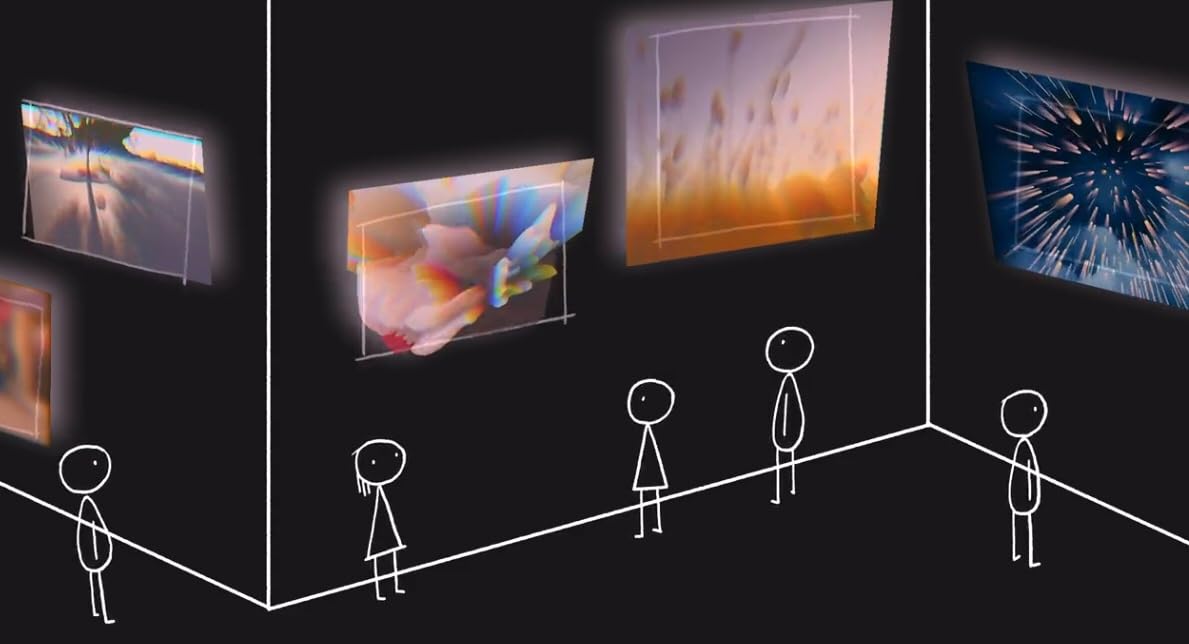
This changes when Emily discovers a cave inhabited by three eggs containing strange creatures. As Emily Prime experiences the memory, she refers to one of the creatures as a “silly thing.” Clone Emily immediately corrects her: “I named it Simon.” In doing so, Clone Emily reveals the deeper significance of naming a living being. Naming establishes recognition, individuality, and emotional attachment. Her insistence on correcting Emily Prime transforms the creature from an anonymous “thing” into someone with an identity—her Simon.
Clone Emily and Simon eventually fall in love, yet she chooses to leave because she misses home, describing it as “something deeper.” Returning to Earth to spend more time with people, she experiences the happiest years of her life. Simon, however, is left inconsolable, emphasising the depth of the bond that naming—and the recognition of personhood—had created.
During this time on Earth she meets her husband, another clone, from the same source as David (the boy in the tube). This time, however, Clone Emily calls him David, clearly asserting her connection to her husband and saying that they loved each other as if they were originals. Unlike her other loves, when David dies Emily feels the loss saying, “I do not have the mental or emotional capacity to deal with his loss but sometimes I sit in a chair late at night and quietly feel very bad. When the night is at its most quiet I can hear death. I am very proud of my sadness because it means I am more alive. I no longer fall in love with rocks”.
Face and name operate subtly throughout the film, yet they become powerful vehicles for expressing what remains unspoken—particularly in Clone Emily’s life. Rather than functioning as simple markers of identity, they reveal recognition, attachment, and personhood, exposing emotions and beliefs that dialogue alone cannot articulate.
This film highlights how personhood and identity are not only something we possess but something we grant to others through the act of seeing and naming them. As fundamental aspects of both cinema and everyday human experience, faces and names are often taken for granted. Yet sustained attention to them reveals the undercurrents that shape our relationships. As a filmmaker, this raises an important question: how might a deliberate focus on faces and names uncover the thoughts, feelings, and beliefs that characters cannot, or choose not to, express?
Starting Points/ Different Perspectives for consideration:
- How can film lean into the relational dimensions of personhood that technology counters? How can film discuss recognition when it no longer requires another person?
- Can AI speak to face and name in a profoundly different and potentially positive way?
- Conceptions of personhood and identity are constantly evolving. Is AI simply another stage in this historical transformation, or does it represent a fundamental break from previous understandings?
- How does story telling accentuate the relational aspects of identity?
Lily Davis
Theologian
Lily is a lifelong lover of film and is studying for a Master's in Theology at Yale Divinity School.
Related

Biblical Lenses
Imagination
The serious pursuit of imagination, and the power of stories to bring new worlds into being.
Lily Davis

Biblical Lenses
Grief
Lament, the multiplicity of memory, and whether AI can participate in it or only simulate it.
Lily Davis

Biblical Lenses
Neighbour
Who is my neighbour? The Good Samaritan, the curated logic of technology, and the neighbour as given.
Lily Davis